

Greenlight PD, LLC – NYS CTLE Provider
1474 Baldwin Boulevard
Bay Shore, NY 11706
Providing NYS CTLE courses for teachers across New York State
Created with

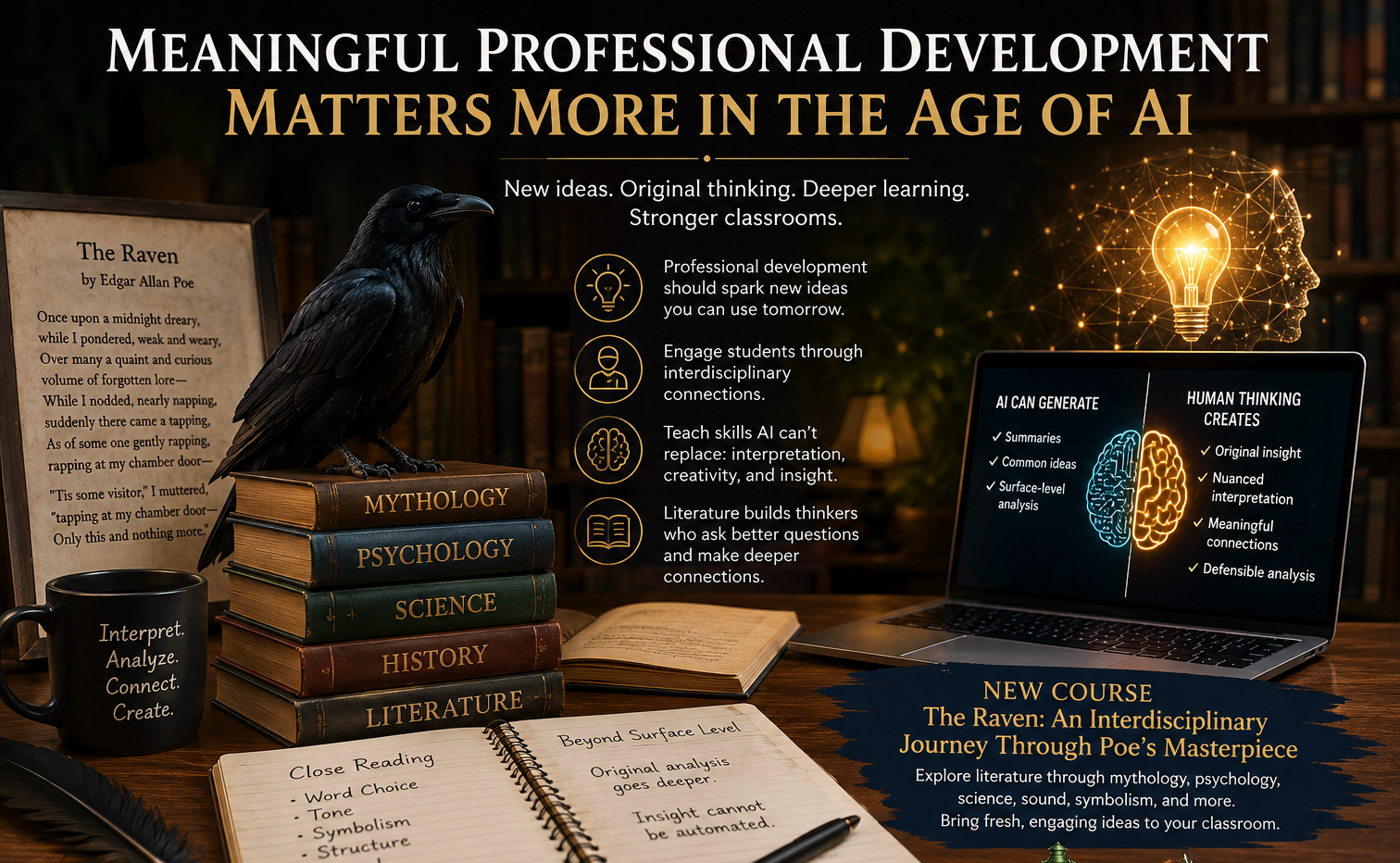
For many teachers, professional development has become something to complete rather than something to experience. Too often, educators sit through workshops that repeat familiar ideas, rely on generic advice, or feel disconnected from the realities of the classroom. At a time when artificial intelligence can instantly summarize a novel, generate quiz questions, or produce a five-paragraph essay in seconds, meaningful professional development matters more than ever.
The strongest professional development courses do not simply provide information that can already be found online. Instead, they challenge teachers to think differently, approach literature from new perspectives, and bring fresh intellectual energy back into the classroom. As AI continues to reshape education, teachers need professional development that encourages authentic analysis, interdisciplinary thinking, and creative engagement with texts.
For English teachers especially, this shift is becoming increasingly important. Students now have access to tools that can generate surface-level literary analysis almost instantly. The challenge is no longer simply getting students to produce writing. The challenge is helping students produce writing that reflects genuine interpretation, close reading, and defensible insight. In many classrooms, teachers are beginning to realize that literary analysis must now rival what can be instantly generated online.
This does not mean teachers should reject AI. In fact, AI can be an extremely useful classroom tool when used responsibly. Students can use AI to brainstorm ideas, organize thoughts, review grammar, or clarify difficult concepts. However, AI should support thinking rather than replace it. The goal of strong instruction is still to help students develop analytical skills that go beyond predictable observations and formulaic responses.
Professional development should help teachers navigate this new reality. The best courses provide educators with ideas that cannot simply be copied and pasted from a search engine. They encourage deeper discussions, interdisciplinary connections, and original approaches to instruction that inspire both teachers and students.
One of the most effective ways to foster authentic engagement is through interdisciplinary learning. Literature becomes far more meaningful when students are encouraged to connect texts to history, mythology, psychology, science, philosophy, and even mathematics. These connections transform reading from passive consumption into active interpretation.
This approach inspired the development of Greenlight PD’s new course on Edgar Allan Poe’s “The Raven.” Rather than treating the poem as a simple Gothic work to summarize, the course explores how Poe’s writing intersects with mythology, sound, symbolism, close reading, and even scientific discussions about ravens themselves. Teachers examine the poem through multiple lenses while also considering how literary analysis can remain meaningful in classrooms increasingly shaped by AI technology.
Courses like these aim to move beyond “one-size-fits-all” professional development. Teachers deserve learning experiences that respect their intellectual curiosity and provide classroom ideas that feel genuinely useful. Students respond when teachers are engaged, challenged, and excited by the material they teach.
In today’s educational environment, meaningful professional development is no longer optional. As technology continues to evolve, classrooms will increasingly value the skills that AI struggles to replicate: interpretation, creativity, synthesis, and human insight. Literature remains one of the most powerful places to cultivate those abilities.
The future of education will not be defined by whether teachers use AI. It will be defined by whether classrooms continue to value authentic thinking and meaningful analysis. Professional development should help teachers build those experiences. The strongest courses do more than provide CTLE hours—they help educators return to the classroom with new ideas worth teaching.
Greenlight PD, LLC – NYS CTLE Provider
1474 Baldwin Boulevard
Bay Shore, NY 11706
Providing NYS CTLE courses for teachers across New York State